Structure sections and a table of contents
Organize an article with headings, then let LaTeX number them and build the table of contents.
On this page
Use structural commands to describe the parts of a manuscript. LaTeX then numbers headings, builds the table of contents, and lets a venue class change the appearance without rewriting your source.
Build an article skeleton#
The standard article hierarchy is \section, \subsection, and \subsubsection. report and book also provide \chapter; article does not. An abstract is an environment rather than a manually styled heading.
\documentclass[10pt]{article}
\usepackage[margin=22mm]{geometry}
\title{Transport in a Porous Medium}
\author{A. Researcher}
\begin{document}
\maketitle
\begin{abstract}
We compare two models for solute transport.
\end{abstract}
\tableofcontents

\section{Introduction}
We state the research question.
\section{Methods}
\subsection{Experimental setup}
We describe the apparatus and protocol.
\section{Results and discussion}
We report the principal comparison.
\section*{Acknowledgments}
We thank the laboratory team.
\appendix
\section{Calibration details}
We provide supporting calculations.
\begin{thebibliography}{9}
\bibitem{darcy1856} H. Darcy, \emph{Les fontaines publiques}, 1856.
\end{thebibliography}
\end{document}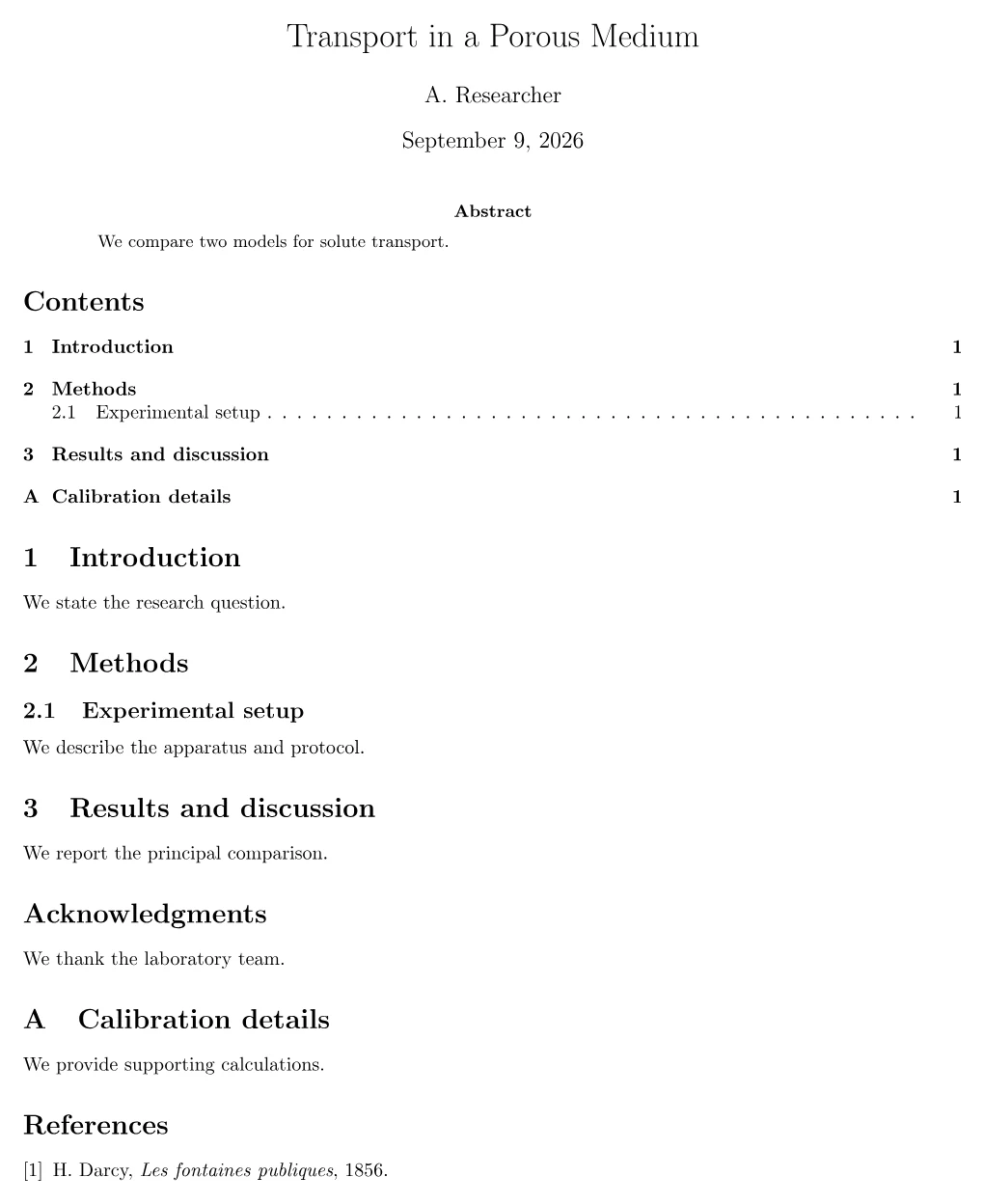
The geometry setting demonstrates page layout only; preserve a venue
template's required margins instead of copying it. The PDF should contain a
title block, abstract, contents list, numbered main sections, an unnumbered
acknowledgment heading, a lettered appendix, and a bibliography. CorTeX performs the normal reruns needed to refresh the table of contents after headings change.
Decide what receives a number#
The starred form, such as \section*{Acknowledgments}, suppresses both the heading number and its table-of-contents entry. If your venue requires that unnumbered heading in the contents, add it explicitly:
\section*{Acknowledgments}
\addcontentsline{toc}{section}{Acknowledgments}
Use this deliberately, not for every starred heading. Bibliography and appendix behavior varies by class and bibliography package.
Let meaning control appearance#
Do not skip from \section to \subsubsection merely to obtain a smaller heading, and do not imitate headings with \textbf. A journal or conference template may rename, renumber, or restyle the hierarchy. Its class file and author instructions remain the authority; preserve their structure instead of forcing the standard article appearance onto them.
For a realistic exercise, rename the Methods subsection to “Numerical model,” add a second subsection called “Parameter estimation,” and compile until both entries appear in the contents. You are ready to continue when changing a heading updates its number and contents entry without manual edits.
Next, learn to format text without weakening that structure. When the manuscript grows, split it into project files without changing the heading hierarchy.