Use brackets and mathematical symbols
Size delimiters around expressions and enter common sets, relations, and Greek letters.
On this page
LaTeX commands record what a mathematical mark means. This gives symbols consistent spacing and lets delimiters fit the expressions they enclose.
Find common symbol commands#
Use these commands inside math mode. Load amssymb for blackboard-bold sets such as \mathbb{R} and symbols such as \varnothing.
| Purpose | Source | Result described |
|---|---|---|
| Greek letters | \alpha, \beta, \Gamma, \Delta |
lowercase alpha and beta; uppercase Gamma and Delta |
| Relations | =, \neq, \approx, \leq, \geq |
equality, inequality, approximation, ordering |
| Sets | \in, \notin, \subseteq, \cup, \cap, \mathbb{R} |
membership, containment, union, intersection, real numbers |
| Arrows | \to, \mapsto, \Rightarrow, \leftrightarrow |
mappings and implications |
| Operators | \sum, \prod, \int, \lim, \log |
large and named mathematical operators |
| Delimiters | ( ), [ ], \{ \}, \langle \rangle |
parentheses, brackets, braces, angle brackets |
Prefer a semantic command to a visually similar copied Unicode character. For example, \in receives relation spacing, while a pasted glyph may not.
Define absolute values and norms once#
The worked inequality assumes that f is Lipschitz with constant L; it
is not a property of every function. State that assumption when adapting the
example to a mathematical argument.
The mathtools package can define paired delimiters with a reusable name. The starred form sizes automatically; an optional size such as \big gives you control when automatic delimiters look too tall.
\documentclass{article}
\usepackage{amssymb,mathtools}
\DeclarePairedDelimiter{\abs}{\lvert}{\rvert}
\DeclarePairedDelimiter{\norm}{\lVert}{\rVert}
\begin{document}
Let \(f\colon \mathbb{R}^n \to \mathbb{R}\) be Lipschitz with constant \(L\).
For every \(x\in\mathbb{R}^n\),
\[
  \abs*{f(x)-f(0)} \leq L\norm*{x}.
\]
The evaluated antiderivative can be written
\[
  \left. \frac{x^2}{2} \right|_{0}^{1} = \frac{1}{2}.
\]
The set \(\{x\in\mathbb{R}: x\geq 0\}\) contains the nonnegative reals.
\end{document}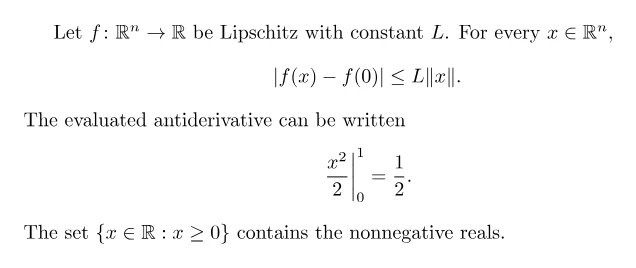
The result shows semantic absolute-value and norm pairs, an invisible delimiter before an evaluation bar, and escaped braces used as visible set delimiters. Every \left must have a corresponding \right; a period after either command creates an invisible side.
Choose delimiter size deliberately#
Automatic \left(...\right) is useful around a fraction, matrix, or tall sum. It can look oversized around shallow material or across carefully aligned lines. In those cases, use ordinary delimiters or a manual size pair such as \bigl( and \bigr), \Bigl[ and \Bigr]. Keep the left and right sizes paired.
Do not use a bare | when the meaning matters: \mid is a relation (“such that” or divisibility), \lvert...\rvert is absolute value, and \Vert is a norm delimiter. Semantic source is easier to review and restyle.
As an exercise, change the Lipschitz inequality to use \abs[\big]{...} and compare it with \abs*{...}. You are done when braces print visibly only where escaped and every scalable delimiter has a mate. Continue with aligned equations.